ADAM — Layer 3: Evolution
How capability and governance mature over time
Evolution in ADAM is not about adding more AI. It is about changing how AI is governed as confidence grows. The point is not expansion for its own sake, but the ability to adapt governance so that it stays proportionate to what teams have learned through real use.
Static governance fails over time because it treats early uncertainty as permanent. When rules do not adjust, organisations either become rigid or drift into informal workarounds. Layer 3 prevents both outcomes by treating maturity as something observable, not assumed. It governs the framework itself, not just the agents inside it.
Layer 3 exists to prevent governance accretion, accidental rigidity, and political escalation around AI decisions. It ensures that as capability matures, the framework remains flexible, evidence-based, and aligned to the North Star.
What “evolution” means in ADAM
Maturity in ADAM emerges from behaviour rather than declarations. It is visible in how consistently teams adopt agents, how reliably validation confirms outcomes, and how clear accountability remains under pressure. It is also visible in how confidently teams can reverse autonomy when signals change.
Layer 3 uses those signals to decide how governance should adapt. When adoption is steady, validation is predictable, outcomes are reliable, and reversibility is routine, the framework can lighten. When those signals weaken, governance becomes more explicit again.
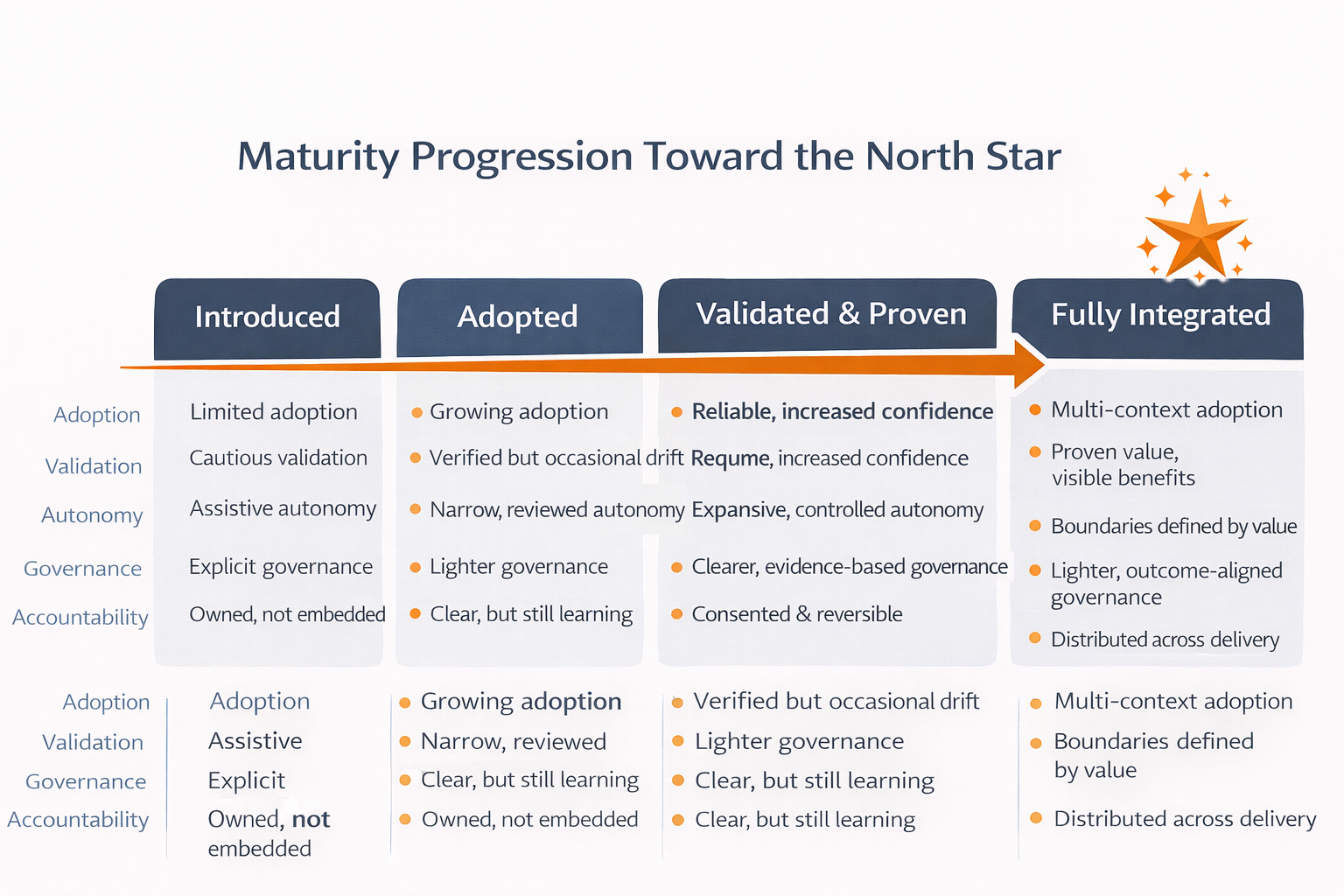
These are states, not steps. Organisations can move forward or backward depending on evidence. The North Star is not an end point; it is an operating condition that must be sustained over time.
How governance adapts as maturity increases
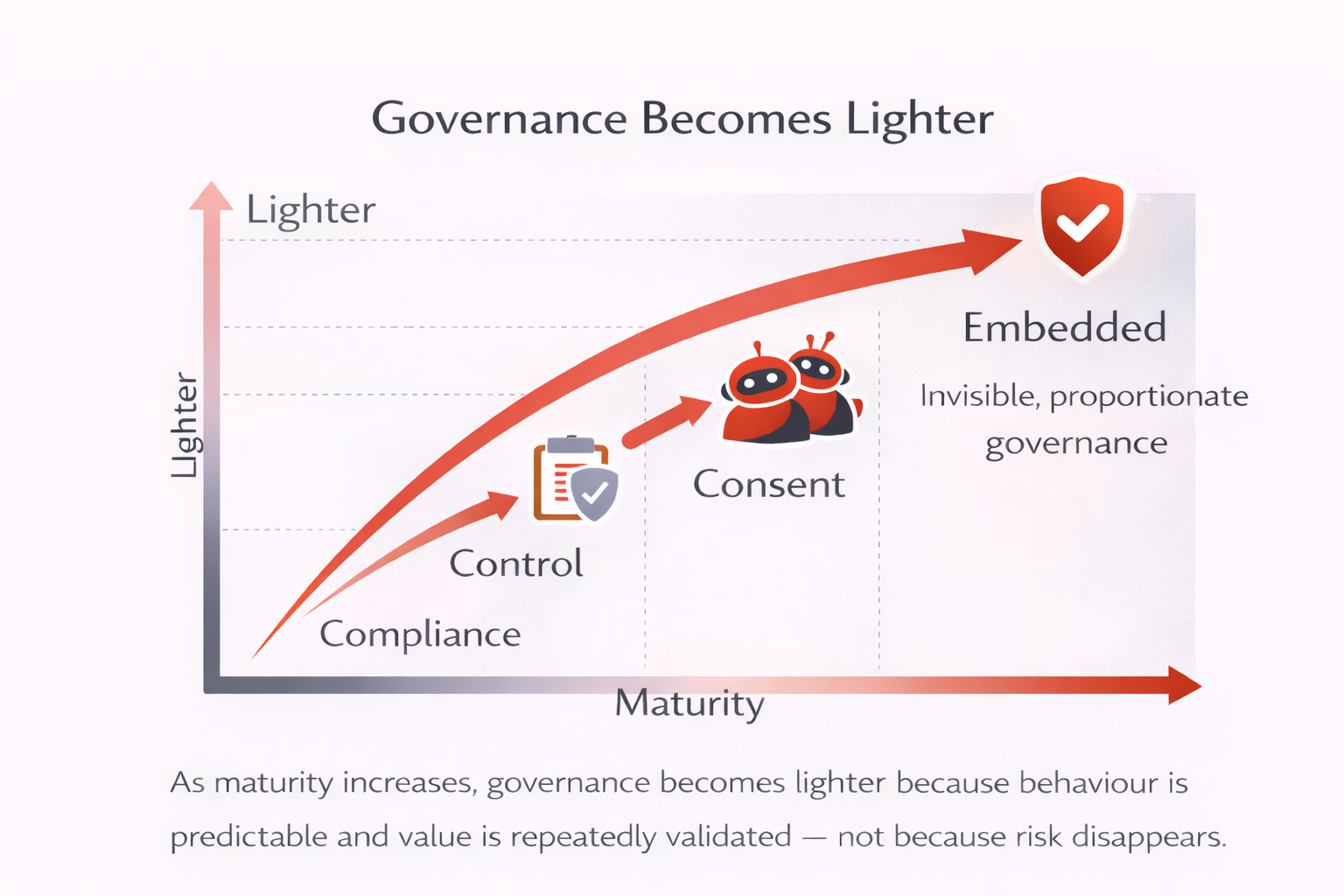
Early-stage governance is explicit because confidence is low. Decisions are written down, controls are visible, and autonomy changes are carefully tracked. As maturity increases, governance becomes lighter because behaviour is proven and outcomes are predictable. It does not disappear; it becomes embedded.
This adaptation is intentional. Layer 3 makes sure the organisation does not carry permanent heavy controls, fall into governance fatigue, or create shadow AI systems to bypass process. By aligning controls with evidence, it keeps governance proportional.
Roles in Layer 3
The Capability Owner in Layer 3 is responsible for long-term direction. This role aligns AI delivery to the North Star, not to day-to-day delivery choices. The ADAM Evolution Steward monitors maturity signals, facilitates reassessment, and updates standards without centralising power. Senior stakeholders set risk appetite and consent to material evolution, but they do not micromanage agents.
In practice, maturity reviews bring these roles together. The Capability Owner frames the long-term objectives, the Steward presents evidence from adoption and validation, and senior stakeholders confirm that the organisation’s risk posture still aligns with the proposed evolution. The decision is explicit, documented, and reversible.
The lifecycle view of AI agents
Evolution includes consolidation and retirement, not just expansion. Successful agents can create replication risk when they are copied into new contexts without re-evaluating assumptions. Consolidation is a maturity signal because it shows that organisations are willing to simplify as confidently as they scale.
Retirement should be planned, not reactive. When agents no longer provide clear value or when context changes, Layer 3 ensures they are wound down deliberately rather than left to linger as legacy dependencies.
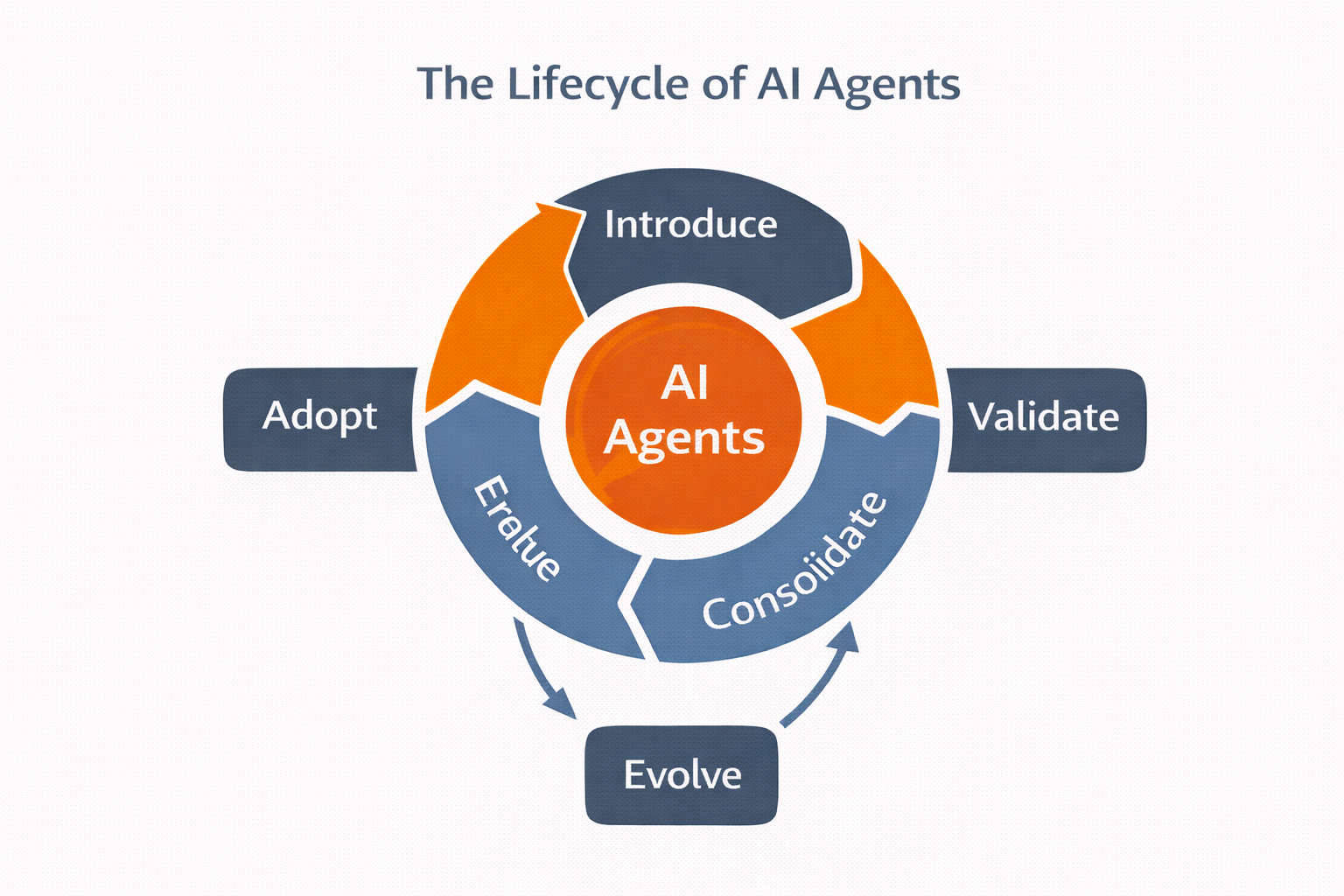
Lifecycle decisions are revisited deliberately because value and context shift over time. Layer 3 ensures that growth does not automatically mean accumulation.
How reuse is handled safely
Reuse is the most common source of hidden risk. Success in one context does not transfer automatically to another. When an agent moves across markets, teams, or regulatory environments, the assumptions that made it safe and valuable must be tested again.
Layer 3 requires the organisation to revisit Layer 1 and Layer 2 assumptions when context changes. An agent that performed well in one market may need new validation in another. This is not duplication; it is the discipline that prevents quiet drift.
Cadence and review
Evolution decisions are periodic, not continuous. This cadence reduces noise and keeps the organisation from relitigating autonomy decisions every week. Reviews focus on evidence, not opinion, and they are scheduled so that teams can prepare validation data rather than improvising.
This rhythm prevents governance from becoming political. It sets expectations for when autonomy can be revisited and ensures that decisions are made with the same evidence that justified the current state.
What success looks like at scale
When Layer 3 works, AI delivery feels stable. Governance is lighter without being lax. Teams feel confident rather than constrained, and leadership gains visibility without micromanagement. Trust grows at the same pace as capability because decisions remain explicit and reversible.
Closing
Layer 3 is what makes ADAM sustainable. Without it, frameworks either ossify or collapse. With it, AI delivery becomes a stable operating model that can evolve with evidence. The result is calm, confident progress over years, not just weeks.
Back to Layer 2: Governance → Back to Layer 1: Delivery → Back to ADAM overview → Templates & Artefacts →