ADAM
AI Delivery & Management
Control without constraint — always with consent
ADAM is the framework that keeps AI delivery stable as it becomes part of everyday work. The problem organisations face is no longer experimentation. It is what happens after AI enters delivery: teams want to move forward, leaders want confidence, and risk and compliance functions need assurance. When those needs compete, progress either becomes uncontrolled or heavy governance slows delivery.
ADAM exists to resolve that tension. It creates a structure in which consent is explicit, accountability remains human, and autonomy can expand only when evidence supports it. This is not a system for saying no. It is a system for moving forward with clarity.
ADAM provides control without constraint, always with consent — enabling people and AI to create value together safely, deliberately, and over time.
Why ADAM exists
AI capability evolves faster than governance. Autonomy tends to increase before validation is strong, and accountability can blur as more work is delegated. Trust is often assumed rather than earned. ADAM exists to ensure that as capability grows, structure, trust, and accountability grow with it.
It is designed for the moment AI begins to matter operationally, not just strategically. The framework makes the transition into delivery deliberate and makes ongoing use verifiable rather than implicit.
What ADAM is
ADAM is an operating framework that sits around delivery. It is how AI is introduced into real work, governed and validated as it is used, and allowed to evolve responsibly over time. It keeps intent visible and decisions reversible, so that autonomy grows only when adoption and evidence support it.
It is not a tool or platform. It is the shared operating discipline that makes AI dependable in day-to-day delivery.
What ADAM is not
ADAM is not a one-time approval process. It is not a centralised AI gatekeeper. It is not a blocker to innovation, and it is not a replacement for delivery or agile frameworks. ADAM is designed to enable progress, not slow it down, by keeping decisions explicit while work continues.
ADAM within the Agency of Agents
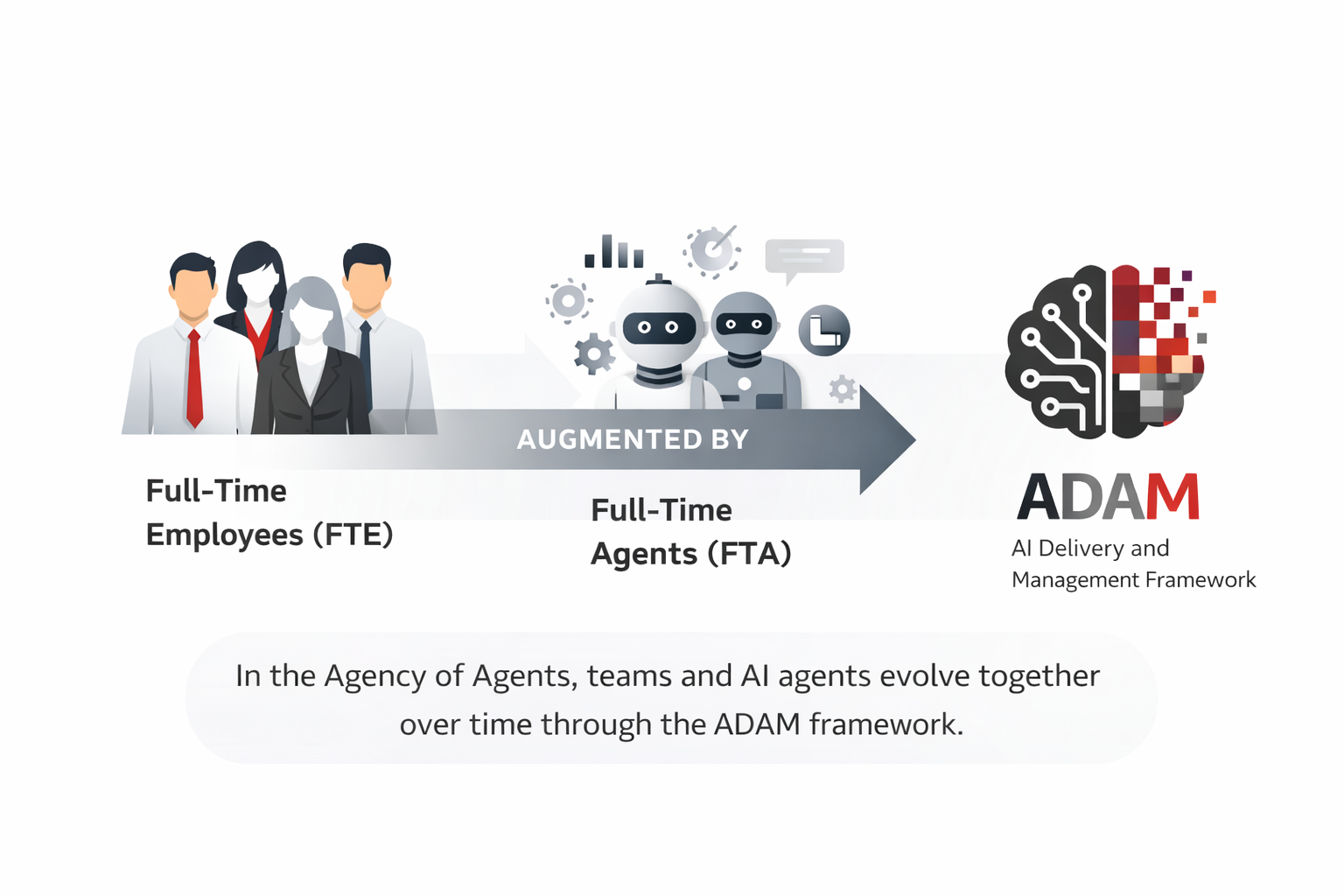
In the Agency of Agents model, people (FTEs) remain accountable for outcomes, intent, and direction. Agents (FTAs) augment teams by reducing effort, increasing consistency, and supporting scale. ADAM exists to ensure this relationship remains intentional, trusted, and sustainable as AI becomes part of everyday delivery.
Motion and stability — ADAM and DAVE
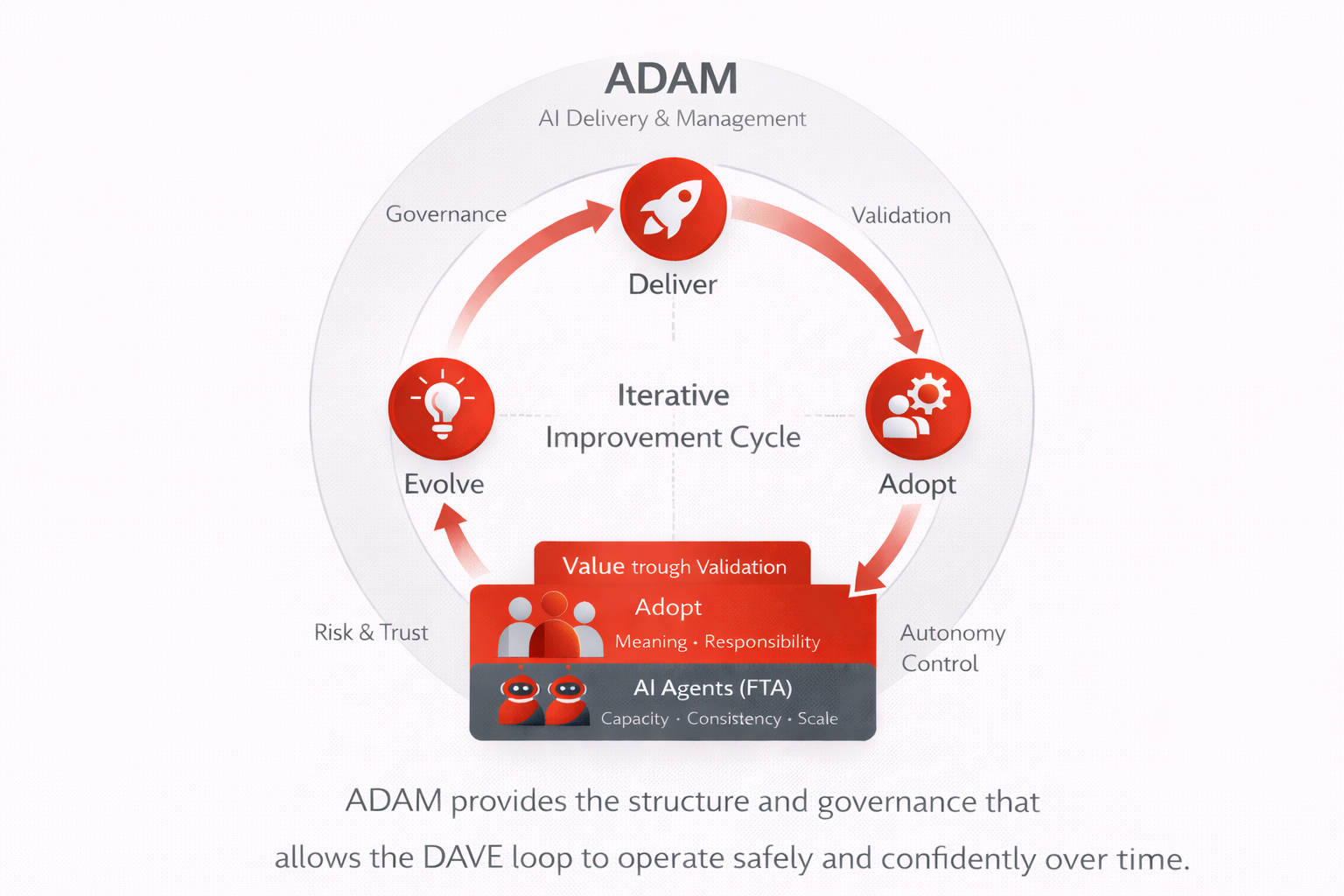
Value within the Agency of Agents is created through the DAVE loop: Deliver · Adopt · Validate · Evolve. DAVE creates momentum. ADAM provides the structure that allows that momentum to remain safe, trusted, and repeatable over time.
How ADAM works (high level)
ADAM is structured as a three-layer framework. Layer 1 covers delivery entry, where ownership, value, and boundaries are defined. Layer 2 covers governance in use, where trust, autonomy, and risk are managed with evidence. Layer 3 covers evolution, where the framework adapts as maturity increases. Each layer has defined actors and roles, clear decision rights, standard artefacts, and explicit control points.
From overview to operation
Roles, decisions, templates, and diagrams for introducing agents into work.
Explore →Trust-but-verify, autonomy control, validation evidence, and risk boundaries.
Explore →Maturity progression, adaptive governance, and continuous improvement over time.
Explore →Designed for maturity, not hype
As maturity increases, governance becomes lighter, not heavier. Autonomy increases where it is justified by evidence. Controls adapt to context rather than accumulating friction. The framework is designed to evolve as confidence grows, not to freeze delivery in early caution.
ADAM and the North Star
Building value through people and AI working together as part of everyday delivery — creating sustained value with clear accountability, governed autonomy, and continuous improvement over time.
ADAM ensures this North Star is operational, not aspirational.
In summary
ADAM provides control without constraint and ensures consent as capability evolves. It stabilises AI delivery as it scales, preserves human accountability, and enables deliberate, sustainable progress. It is the framework that allows organisations to move forward with AI confidently.