
Maturity
Moving from experimentation to sustained value
AI doesn’t fail because models aren’t smart enough. It fails because organisations don’t move beyond pilots.
Maturity is a capability journey: adoption + validation + accountable autonomy over time.
- Adoption must be real (used in day-to-day work)
- Validation must be repeated (evidence, not enthusiasm)
- Autonomy must be earned (FTE → FTA progression)
- Governance becomes lighter only as behaviour becomes predictable
- Accountability always stays human and local to the domain/team
Why maturity matters
Without a shared view of maturity, organisations either stay stuck in experimentation or scale too fast and lose trust.
Maturity makes progress deliberate and reversible.
- Prevents “pilot sprawl” and fragmentation
- Creates confidence for leaders without slowing teams down
- Makes autonomy a controlled choice, not an accident
What we mean by maturity
Maturity is not “more AI” or “more automation”; it’s reliable value creation with clear accountability and proportionate governance.
- People use the capability consistently
- Outcomes are measured and repeated
- Boundaries are clear and understood
- Decisions can be revisited safely
How maturity progresses
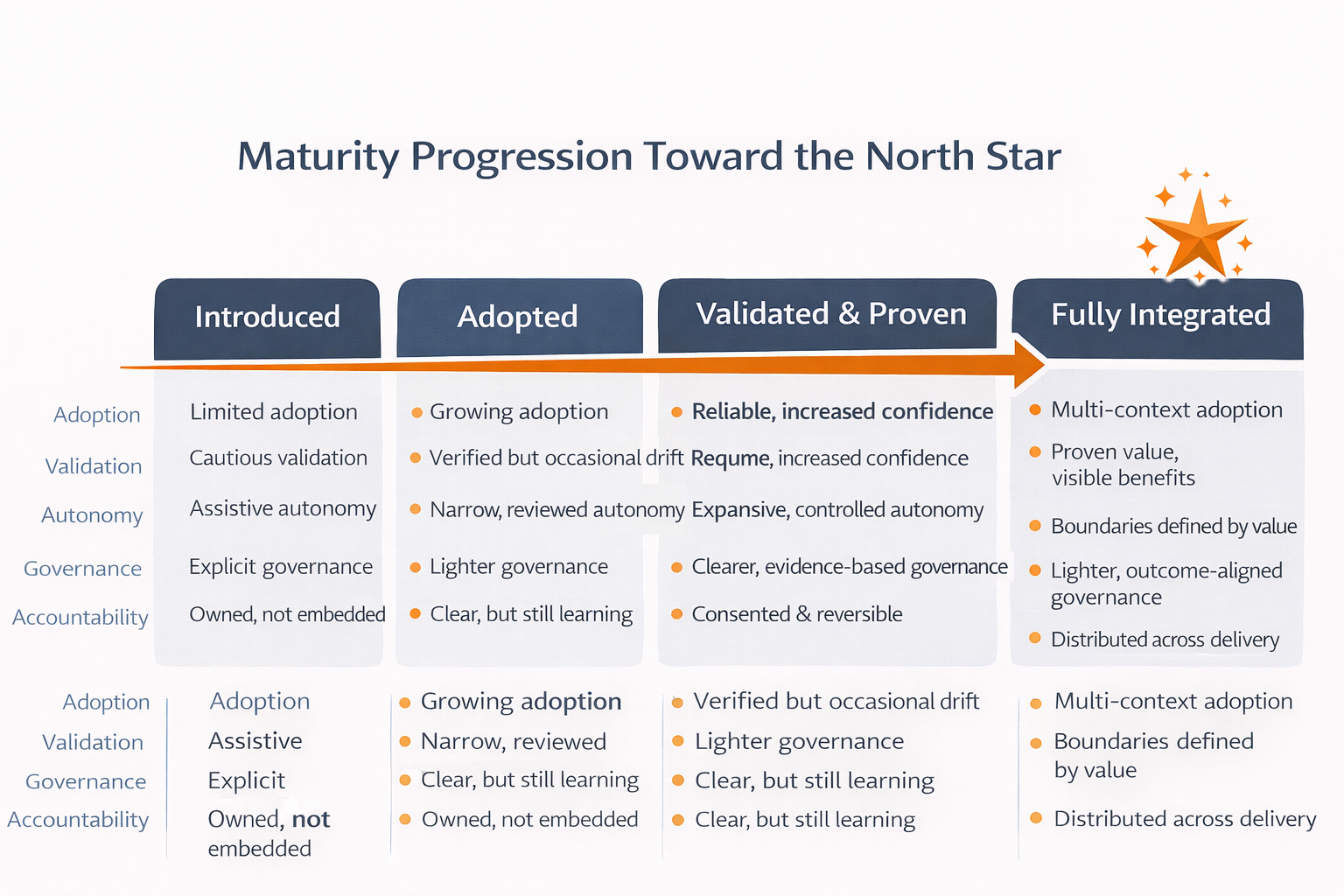
The four stages below match the diagram and can vary by domain. Some areas may be at different stages depending on context and risk.
Introduced
Early activity is cautious and local. Teams are learning what works and what does not.
- Adoption: Limited adoption
- Validation: Cautious validation
- Autonomy: Assistive autonomy (humans decide/approve)
- Governance: Explicit governance (visible guardrails)
- Accountability: Owned, not yet embedded (responsibility exists but isn’t habitual)
Adopted
Usage grows and patterns begin to form, but teams are still learning where drift occurs.
- Adoption: Growing adoption
- Validation: Verified, but occasional drift
- Autonomy: Narrow, reviewed autonomy (bounded actions)
- Governance: Lighter governance (less friction, still clear)
- Accountability: Clear, but still learning (habits forming)
Validated & Proven
Evidence is repeated and confidence grows. Autonomy expands within clear thresholds.
- Adoption: Reliable adoption across the target workflow
- Validation: Repeated proof → increased confidence
- Autonomy: Expansive but controlled autonomy (thresholds/monitoring)
- Governance: Clearer, evidence-based governance
- Accountability: Consented & reversible (autonomy can be reduced safely)
Fully Integrated
Capability is embedded across related processes and governance feels proportionate.
- Adoption: Multi-context adoption (used across related teams/processes)
- Validation: Proven value and visible benefits
- Autonomy: Boundaries defined by value and risk
- Governance: Lighter, outcome-aligned governance
- Accountability: Distributed across delivery (teams own end-to-end)
Governance becomes lighter
Governance does not disappear; it becomes embedded and proportionate because behaviour is predictable and value is repeatedly validated.
The four phases below match the governance diagram and represent an evolution of how controls feel to teams.
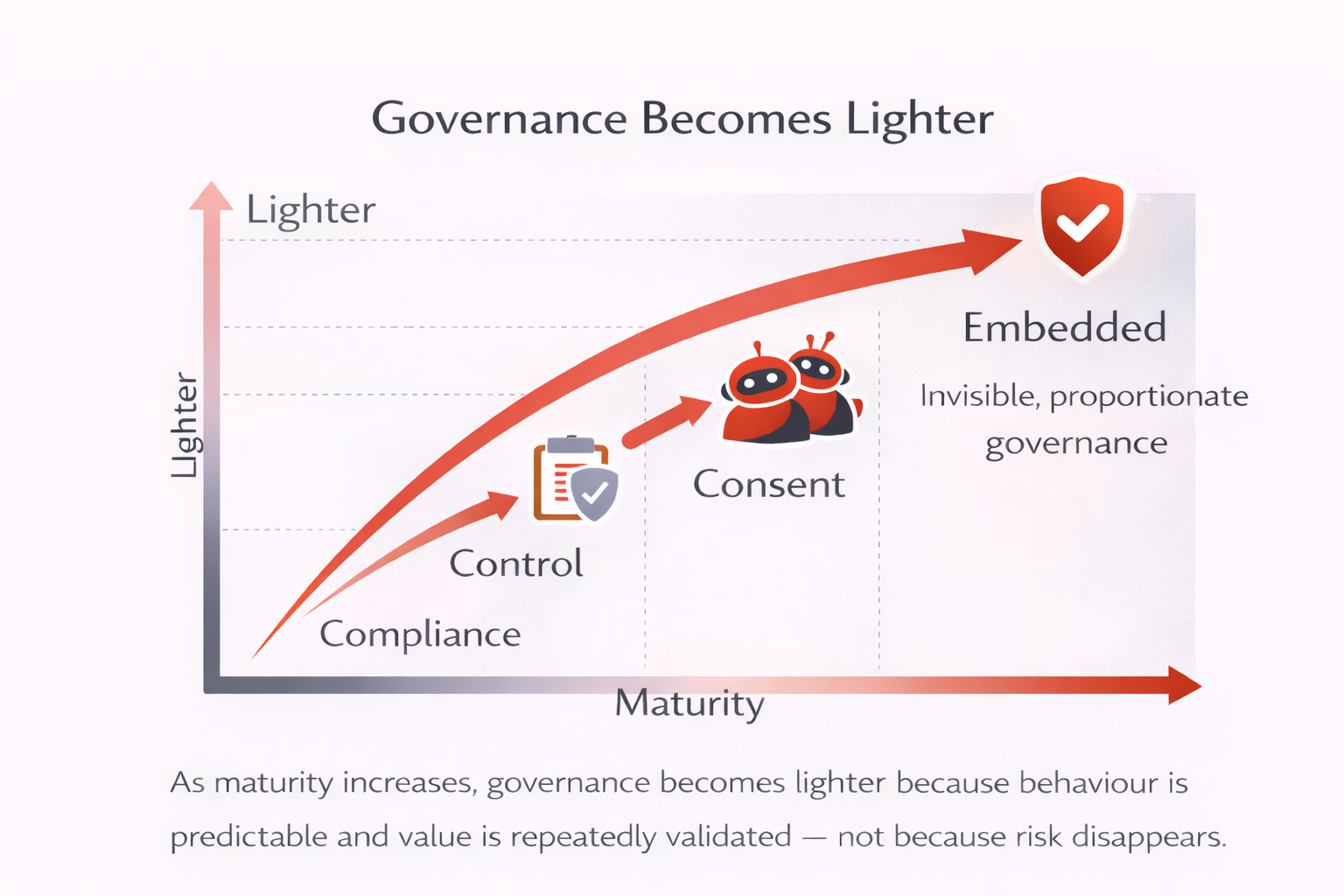
Compliance
- Rules are explicit and visible
- Focus is “don’t get it wrong”
- Strong approvals and tight boundaries
Control
- Controls become repeatable patterns
- Monitoring starts to replace manual checking
- Teams learn what “good” looks like
Consent
- Autonomy is granted deliberately for specific outcomes
- Escalation paths are clear
- Autonomy is reversible without drama
Embedded
- Governance is largely invisible for teams doing the right thing
- Controls are built into tooling and architecture
- Focus shifts to outcomes and continuous validation
Practical takeaways
If you’re unsure where you are, start by looking at adoption and validation.
- If adoption is low → simplify the experience (KISS), embed into workflows
- If validation is inconsistent → define measures, monitor drift, repeat proof
- If autonomy is growing → ensure thresholds, escalation, rollback exist
- If governance feels heavy → check whether behaviour is predictable and value is evidenced
Maturity is how you reach the North Star—deliberately, safely, and with shared ownership. →